




紀要(ICT Progress)編集後記に代えて:車の両輪の重要性
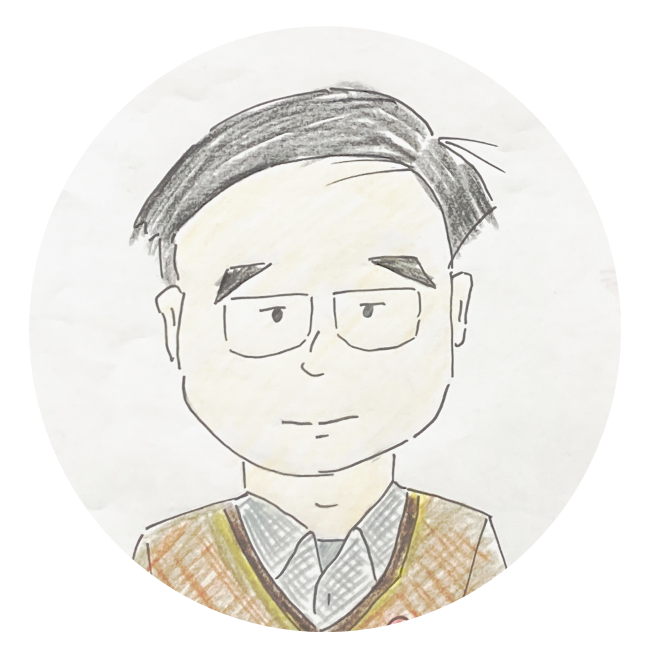
Illustration by Prof. Michihiro Hayashi (used with permission)イラスト:林 道大先生(掲載許可済)
こんにちは。国際理工学科の大塚 作一です。今回、2021年4 月の着任以来5年間の国際高専勤務を終えるにあたり、最後の業務としてICT Progressの編集統括を担当させていただきました。
ICT Progressは国際高専の教職員による教育改善の実践事例をまとめた年次報告書であり、教育の質の向上を目的として毎年発行しているものです。昨年は、規約類を整備しWeb上で外部公表を行うように発行形式を改めました。2回目の今年は、さらに規約類を補訂し、内容についてもより充実させました。
本記事は「ICT金沢ジャーナル」の記事としては少々異色で堅苦しい内容になりますが、このジャーナルの読者である一般の皆様にも国際高等専門学校がSTEAM教育(* 注参照)をどのように実践しているかを具体的にご理解いただくきっかけとなれば幸いです。
* 注:Science(科学)、 Technology(技術)、 Engineering(工学)、Mathematics(数学)を統合的に学習する「STEM教育(ステムきょういく)」に、 さらにArts(リベラル・アーツ)を統合する教育手法
さて、改めて言うまでも無いことかもしれませんが、文部科学省のホームページ(https://www.mext.go.jp/a_menu/koutou/kousen/index.htm)から高等専門学校の主要な特色を引用すると、「高等学校と同じく、中学校を卒業した方が入学することができ、入学後は5年一貫で、一般科目と専門科目をバランスよく配置した教育課程により、技術者に必要な豊かな教養と体系的な専門知識を身につけることができます。」とあります。特色と表裏一体となる教育の特殊性としては、入学時の対象は「初等中等教育」で卒業時の扱いは「高等教育」に位置付けられることが最大の要因だと考えらます。その特殊性に起因して、表現は異なりますが、車の両輪、即ち、シラバスとしての「一般科目と専門科目」、および、学修結果としての「豊かな教養と体系的な専門知識」が記載されております。
ここで、本内容を上述のSTEAM教育と照らし合わせてみると、”T”と”E”は明らかに後者に属しますが、”S”と”M”は中間的、そして、”A”は前者に属します。したがって、教育の実践においては、両者は簡単に割り切れるものではなく、科目間の連携や時期等にも細心の注意が必要であることがご理解いただけるものと思います。
そこで、教職員自らが「教育改善の個別実践事例」を積み重ねてゆくことが重要です。ここでは、実践と発表・記録(情報共有)が車の両輪であり、記録である「ICT Progress」では、記事の内容(質の維持)と読みやすさが車の両輪となります。また、学校内部では教職員相互の発表・討論の場として、毎年「教育成果発表会(本年度は3月26日開催)」も開催しております。そして、これらは学生さんたちへのSTEAM教育の実践の鏡としても捉えることが出来るでしょう。その意味で、この掲載記事がこれから高専への入学を検討されている一般の皆様のお目に留まれば幸いです。
最後に、鹿田 正昭校長のリーダーシップの下、執筆者として多忙な業務の間をぬって執筆にご尽力いただいた皆様、編集の立場として査読にご協力いただいた皆様(特に英文校閲にもご協力いただいたステファニー・レノルズ先生)、そして、記事の書式を丹念に整えて頂いた事務局の南戸 仁美さんにこの場をお借りして改めて感謝の意を表します。併せて、今後も、国際高等専門学校が、多様性を基軸にした独自性を活かし、益々ご発展を遂げられることを祈念しております。
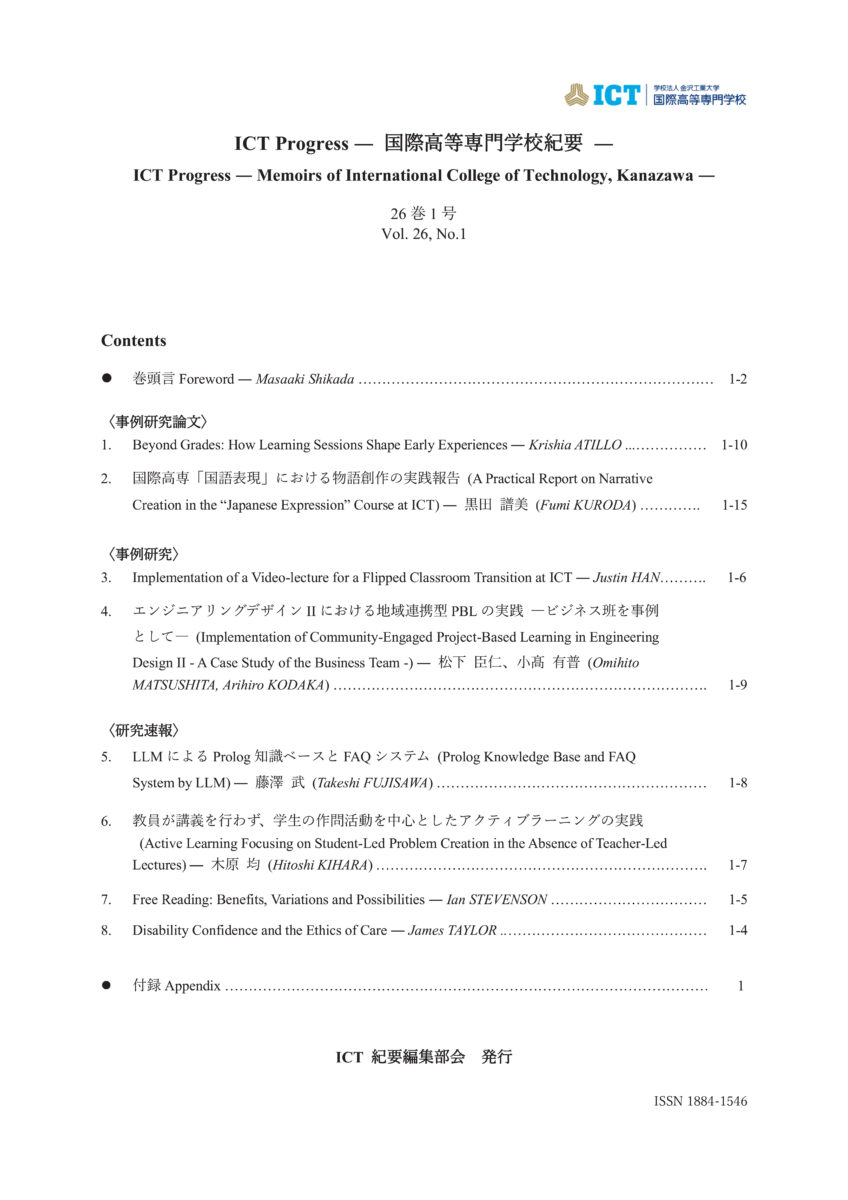
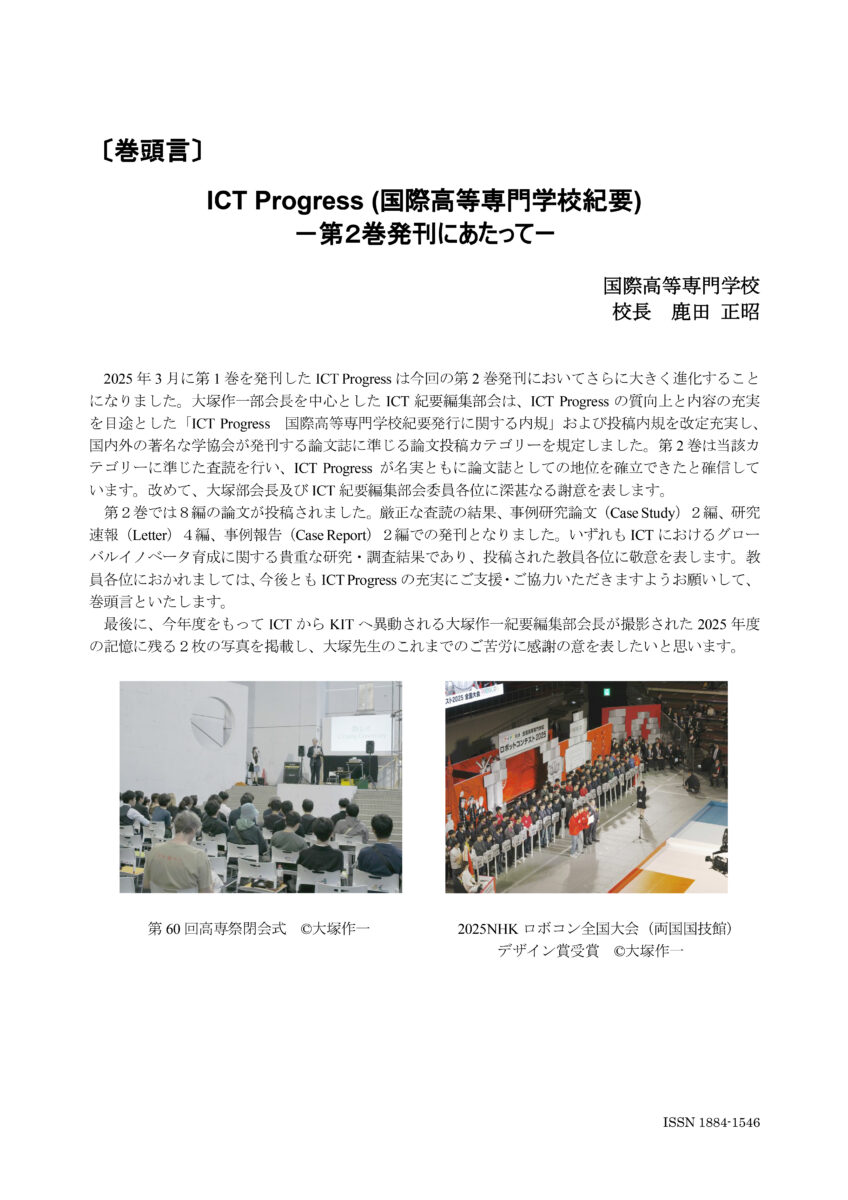
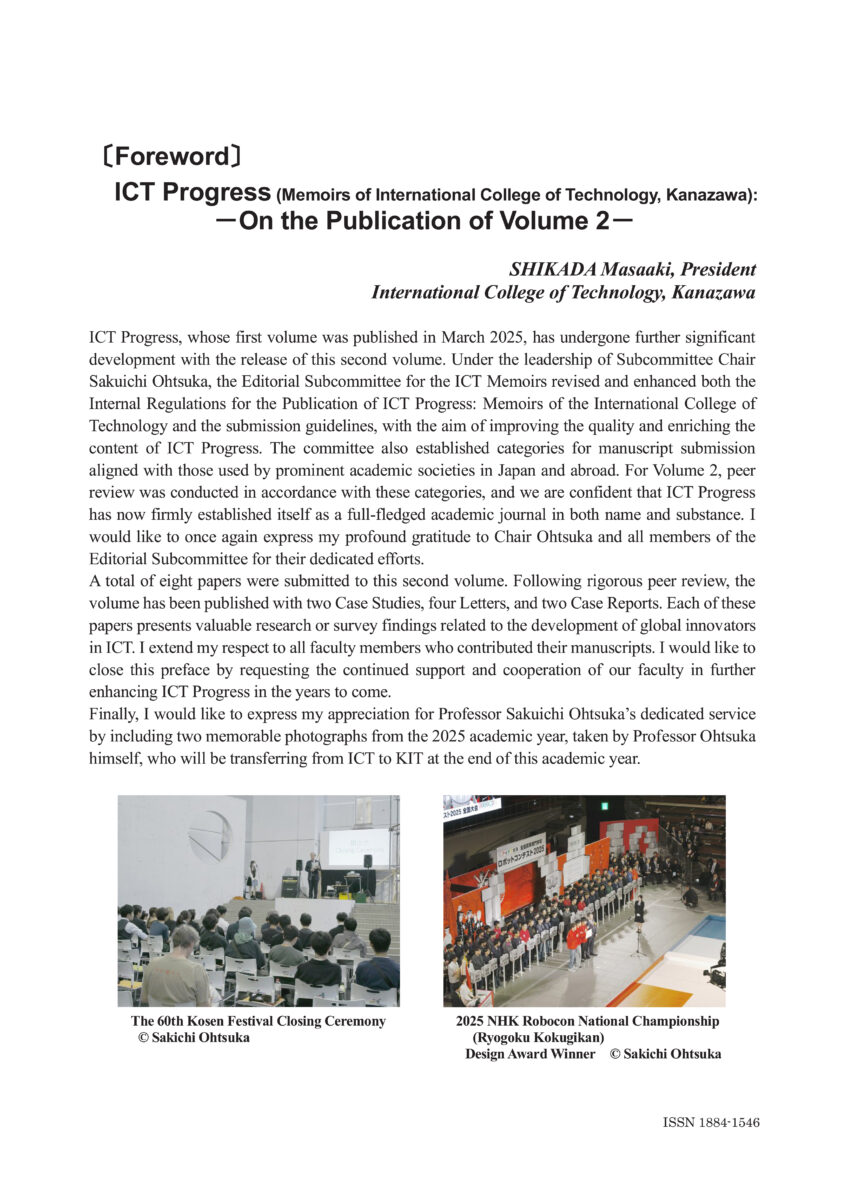
以下に本年度のICT Progress の目次と巻頭言を掲載しておきます。電子版の紀要(ICT Progress)は以下のURLよりご参照いただけます。また、最後の挿入写真は手許にあった国際高専の「車の両輪」を超えた多様性を象徴する一齣として、昨年度開催の第1回チーム対抗駅伝大会(2024年11月8日実施)の写真を掲載させていただきます。初めてご覧になる一般の方々にも、学生さんと教職員の間の一体感、そして、国際高専の名に恥じない国際性豊かな一体感を感じていただければ幸いです。
■電子版の紀要(ICT Progress)は以下のURLよりご参照いただけます。
URL:https://kitir.kanazawa-it.ac.jp/infolib/meta_pub/G0000002repository
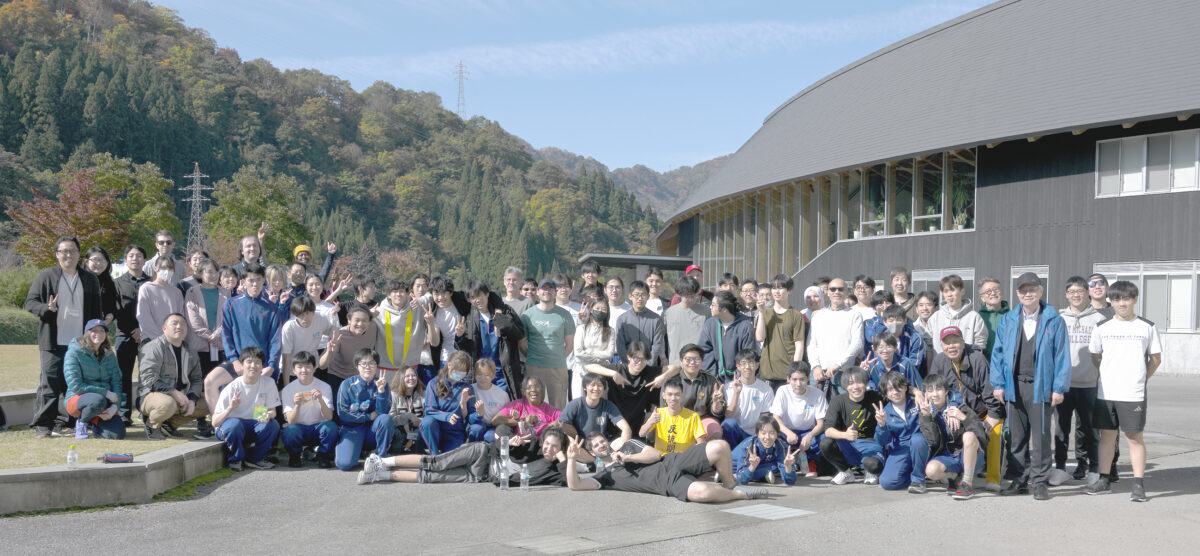
Photography: Sakuichi Ohtsuka (retouched by the photographer)写真撮影:大塚 作一(本人のレタッチによる)
大塚 作一
Editor’s Note for the Memoirs (ICT Progress): Importance of Complementarity Everywhere
Illustration by Prof. Michihiro Hayashi (used with permission)イラスト:林 道大先生(掲載許可済)
Hello. I am Sakuichi Ohtsuka from the Department of Science and Technology. At the conclusion of my five-year tenure at the International College of Technology, Kanazawa, having joined in April 2021, I have had the honor of being the chief of the editorial committee of ICT Progress as my final assignment.
ICT Progress is an annual report compiling practical examples of educational improvement initiatives by faculty and staff at the International College of Technology, published each year with the aim of enhancing the quality of education. Last year, we revised the publication format to include updated regulations and made the report publicly available online. For this second edition, we have further revised the regulations and enriched the content.
While this article may be somewhat unconventional and formal for the “ICT Kanazawa Journal,” I hope it will serve as an opportunity for the general public—the readers of this journal—to gain a concrete understanding of how the International College of Technology, Kanazawa, implements STEAM education (*see note).
* Note: An educational approach that integrates Arts (Liberal Arts) into "STEM Education" (Science, Technology, Engineering, and Mathematics).
While this may go without saying, quoting the key characteristics of KOSEN (The National Institute of Technology) from the Ministry of Education, Culture, Sports, Science and Technology’s website (https://www.mext.go.jp/a_menu/koutou/kousen/index.htm): “Like high schools, these institutions admit students who have graduated from junior high school. After enrollment, students follow a five-year integrated curriculum that balances general and specialized subjects, enabling them to acquire the broad general knowledge and systematic specialized expertise necessary for engineers.” As for the unique nature of the education that is inextricably linked to these characteristics, the most significant factor is likely that students are classified as being in "primary and secondary education" upon admission but are treated as being in "higher education" upon graduation. Due to this unique nature, although the phrasing differs, the curriculum is described as a pair of items requiring collaboration: "general and specialized subjects" as the syllabus, and "a rich general education and systematic specialized knowledge" as the learning outcomes.
Next, when we compare this content with the aforementioned STEAM education, “T” and “E” clearly belong to the latter, “S” and “M” are intermediate, and “A” belongs to the former. Therefore, in educational practice, the curriculum cannot be easily separated, and I believe you will understand that meticulous attention is required regarding coordination between subjects and timing.
Consequently, it is crucial for faculty and staff to accumulate their own “individual case studies of educational improvement.” Here, practice and presentation/documentation (information sharing) go hand in hand. Similarly, in the documentation platform “ICT Progress,” the quality content of the articles and readability are equally important. Additionally, within the school, we hold an annual “Educational Research Presentation Session” (scheduled for March 26 this year) as a forum for mutual presentations and discussions among faculty and staff. These activities can also be viewed as a mirror reflecting the practice of STEAM education for our students. In that sense, we would be delighted if this published article catches the attention of the general public who are considering enrolling in a National Institute of Technology (KOSEN).
Finally, I would like to take this opportunity to once again express my gratitude to everyone who, under the leadership of President Masaaki Shikada, took the time to write these articles despite their busy schedules; to everyone who assisted with the peer review process (especially Ms. Stephanie Reynolds, who helped with the English proofreading); and to Ms. Hitomi Nanto of the Administrative Office, who meticulously formatted the articles. I also wish the International College of Technology, Kanazawa, continued success in the future, building on its unique strength of diversity from various perspectives.
Below is the table of contents and foreword for this year’s ICT Progress. The electronic version of the Memoirs (ICT Progress) is available at the URL below. Additionally, as a photo posted at the end, I have included a snapshot from last year’s 1st Inter-Team Ekiden Relay Race (held on November 8, 2024), which symbolizes the diversity that goes beyond the “going hand in hand”—a concept often associated with the International College of Technology, Kanazawa. We hope that even those viewing this for the first time will sense the unity between students and faculty, as well as the rich international spirit that lives up to the name of the International College of Technology, Kanazawa.
■The electronic version of the Memoirs (ICT Progress) is available at the URL below.
URL: https://kitir.kanazawa-it.ac.jp/infolib/meta_pub/G0000002repository
Photography: Sakuichi Ohtsuka (retouched by the photographer)写真撮影:大塚 作一(本人のレタッチによる)
Sakuichi Ohtsuka