





Hello. My name is Hamish Barnetson, a new English teacher at ICT. Nice to meet you all! I’m from the UK. I was born in Scotland but moved around a lot as a child, so I am used to changes. I also went to boarding school when I was 7 years old, so I know what it’s like to be away from home! I have lived and worked in Japan for over 10 years in several regions including Tokyo, Saitama, Chiba and Niigata. I recently moved to Hakusanroku Campus with my family, and we are really enjoying living here so far. I am looking forward to meeting all the staff and students here.
So far, it has been really interesting to see the students participating in classes that are basically all in English. They seem to be making good friends and trying their best with all the new information. They are enjoying some friendly competition in classes, and getting used to interacting, working together and presenting their ideas in English.
As I mentioned, I have a family here so you might see them wandering around campus sometimes. Please say hello to them if you get a chance. I’m glad they can be in such an international environment and meet people from many different countries. Plus, what a great place for outdoor activities! I hope to get involved in some outdoor activities with students in the future.
Anyway, I will try my best to help the students with their English skills, and I really hope they enjoy their time here. I encourage them to use English as much as possible in my classes. It is usually challenging at first but after a while it should start to feel more natural hopefully.
Let’s enjoy this first year together at ICT!


Hamish Barnetson
 Hello! I’m Sharmee Abuan, a new Learning Mentor (LM) at Hakusanroku Campus. I studied Information Technology in university and spent several years working in the field, doing tasks related to network configuration, data transactions, and system development in the Philippines.
At Hakusanroku Campus, we hold Learning Sessions (LS) in the evening where students work on their homework, projects, or practice their English. LM are there to help out whenever students need support or guidance. While my main role is during LS time, I also join afternoon classes to observe and get a better idea of how students learn in class. I am hoping to use my IT background to help students figure out solutions to their tasks, when they have computer-related issues or get stuck with online tools.
In my first month of working, I have encountered several teachable moments while interacting with other LM’s and students and I hope to share them here. Little moments that make me reflect on what skills I still need to work on to hopefully become an effective LM.
1. The Communication Trick - The students are currently doing a self-guided reading program that ensures each student is learning at the appropriate level and advancing at their optional pace called SRA during LS and we try to bring up the learned words and content when chatting with them. This, hopefully, would help reinforce their language skills.
2. I do, We do, You do - One evening during LS, a student came over and asked for help with their Computer Skills homework. As I have observed from what other LM’s do, we sat down together and worked through the task step by step at first. I showed them how it’s done on my laptop so they could follow along. Afterwards, we ask them to do it by themselves and it is always nice to see when they can finally work independently.
3. Working Together Works - At LS, students also get the chance to help each other. It is amazing to see students sitting together and talking about school. For example, trying to solve that one challenging quiz of the day and learning tips and tricks from each other.
I learn something new each time I work with the students, especially during the two hours I spend with them in the evening at LS. Little by little, it’s helping me understand how to support them better.
When I first heard about what LM’s do, the possibilities for growth not only on the students’ side but also for my personal growth made me feel excited. It felt like I’d be learning alongside the students as I support them, and that idea really motivated me. Now that more than a month has passed since the semester started, I’ve seen students gradually open up. The first-year students are still adjusting to their new environment but are becoming more confident, while the second-year students are stepping up and even helping their juniors.
Right now, I’m still in the process of adjusting and learning, just like the students. I plan to use this first year to grow by studying many of the subjects they’re learning, especially the computer-related ones, and by observing what makes an effective LM. I hope that by doing so, I can support the students even better in the years to come.


Sharmee Abuan
 Hello, I’m Kentaro Takano, a 3rd year student. About one month has passed since I arrived in New Zealand.
I found a food that I like in New Zealand: meat pies. When I heard the word “pie,” I could only imagine pies with fruit, which I don’t like. Therefore, I thought I wouldn’t enjoy pies here. But when I went to a store, I saw pies with meat being sold, and they were very tasty. After that, I talked to my mother about it, and she told me that I had eaten a pie with sausages in Japan before.
-

Package of Butter Chicken バターチキンパイのパッケージ
-

Very Tasty Butter Chicken バターチキンパイ


I have spent too much money since I came to New Zealand, probably because of the delicious meat pies. I thought the price was high, and I didn’t feel like I was spending money because I used a card when paying. I realized that this wasn’t good for me, so I started using cash as much as possible to feel the money decreasing.
Next, I will introduce some sightseeing places. On Thursday, April 24, 2025, we went to Saint Clair Beach. I had walked around the area several times before, but it was my first time going onto the beach. The funniest thing was that when I walked on the beach, the waves came crashing many times, and my shoes almost got wet. However, walking on the beach in shoes is quite difficult, so next time I’ll wear sandals instead.
-

St. Clair Beach (Photo taken facing left from where I stood)セントクレア・ビーチ (私が立った場所から左を向いて撮った写真)
-

St. Clair Beach (Photo taken facing right from where I stood)セントクレア・ビーチ (私が立った場所から右を向いて撮った写真)


On the same day, we headed to Tunnel Beach, but we stopped halfway and gave up. Walking was fun because I like walking, and I was with my friends. What I remember most was climbing the stairs—there were 285 steps. Next time, I will plan better, and I’m looking forward to going to Tunnel Beach again.
-

Looking up from the bottom of the 285 steps階段の上から撮影した風景
-

View from the summit of the staircase285段の階段下から撮影


On Friday, April 25, we went to Baldwin Street, which is the steepest street in the world. I had been there before with my host family, but we only looked at it from the bottom. Thus, this was my first time going up and down the street. The view from the top was beautiful, and I felt a sense of accomplishment when we reached the top. I had wanted to visit Baldwin Street since I was in Japan, and it’s the best sightseeing place I’ve been to since I started living here.
-

Photo taken from the bottom of the world’s steepest street世界一急な坂と言われる坂の下から撮影した写真
-

At the top of the street with my friend Ruuna Nakazawa坂の上から友達の中澤 琉月さんと共に


On the same day, we also went to Signal Hill Lookout. I had been there before with my host family by car, but this time I went on foot for the first time. I felt good because the weather was nice and the view was great. On the way there, we walked on a road with a narrow footpath, so I was a bit scared. On the way back, we took a hiking track. Although the path was slippery, I liked the return route more than the way there. I will use the track next time.
I will find new sightseeing places, and I want to enjoy sightseeing for the remaining 10 months or so.
Kentaro Takano
-

On the hiking trail to Signal Hill シグナル・ヒル展望台までのハイキングトラックにて
-

View from Signal Hill Lookoutシグナル・ヒル展望台からの景色


Hello. I am Masaaki Shikada, ICT President.

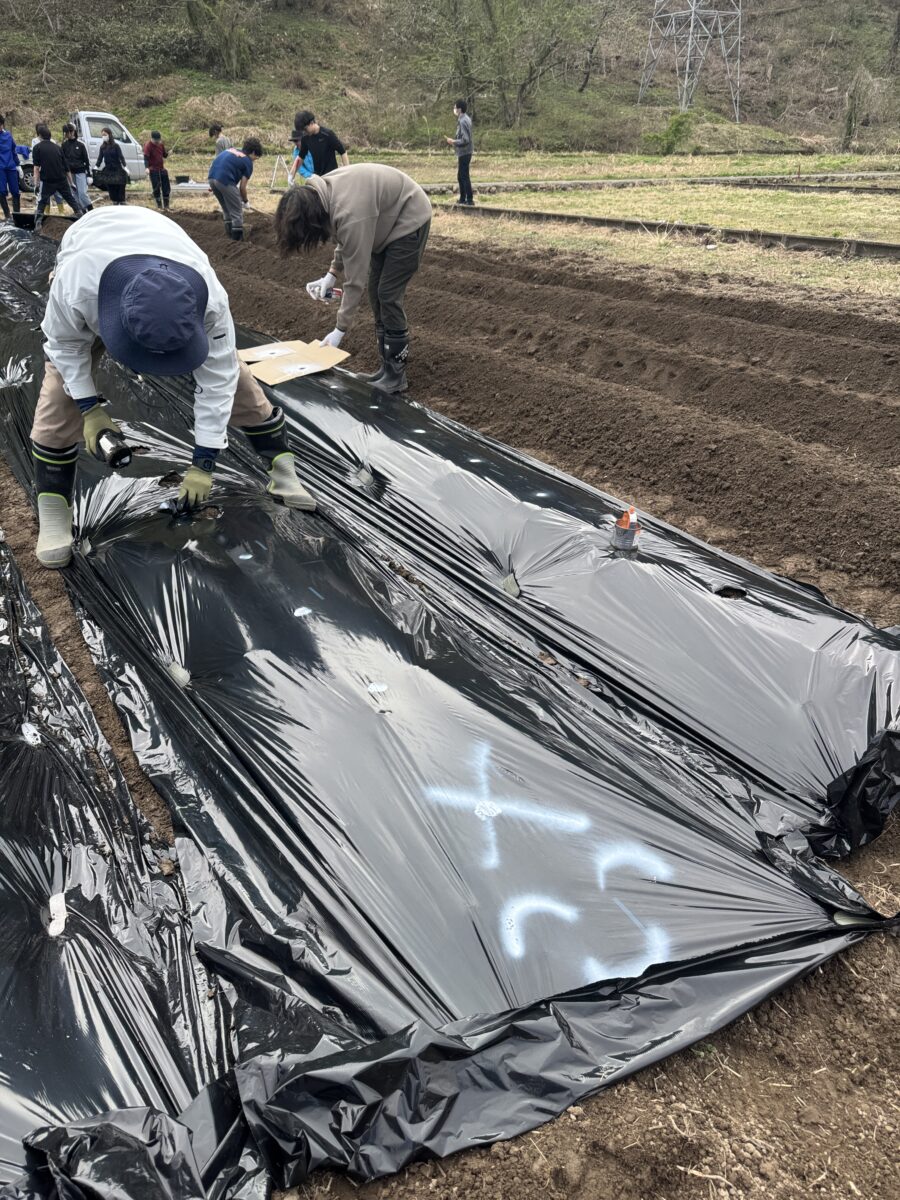
On Thursday, April 24th, 2025, I helped plant Engineering Design II's "Kosen Beniharuka" seedlings for the third time. This time, I had a meeting at Kanazawa Campus, so I couldn’t travel to Hakusanroku Campus until after the meeting ended. By the time I arrived, the ridges had already been prepared and the planting had begun. This year I planted the second row from the west side. The soil was quite wet this winter due to the heavy snowfall, but I felt this made the work easier.
This is the third time I have planted seedlings, and although I am getting used to it, I still worry about whether the seedlings I planted will grow well. The year before last, the potatoes did not grow very large, probably because it rained a lot. Last year, good weather and moderate rainfall resulted in large potatoes. We expect this year's crop to be as good as last years.
All 2nd year students, Engineering Design II teachers, and Learning Mentors Domyson Abuan sensei and Sharmee Abuan sensei joined us to complete the seedling planting before 16:00. Then electric fences were installed and measures were taken to prevent damage from animals. We hope for another good harvest this year, following on from last year.
Our school will hold an open campus on Saturday, November 1st and Sunday, November 2nd. In conjunction with this event, the annual baked sweet potato sale will be held at the Sena Road Station. If you have time, please visit the Sena Road Station and try some potatoes!
Click here for more details about Open Campus




Masaaki Shikada
Getting to Know You
Pauline Baird an English teacher at ICT.
What is the thing you own but others use the most? Yes, you guessed it correctly. It is your name!
Students in their first classes are often nervous. Some parents at home are nervous, too, for a good reason because classes at ICT are in English. However, when the “Bridge English Chemistry” class began with an ice-breaker activity called “My Name …,” the class went from silent to a buzz of activity, with loud voices speaking Japanese and English and laughter.
My Name
“My name is Toshimune. I am ‘Toshi_____,’ my brother is ‘Toshi ____’, my father is ‘Toshi _____,’ and my grandfather is ‘Toshi _____.’ All men in my family have the “Toshi” [in the name],” one student was delighted to share. He was so happy telling and writing the story in his most beautiful English. The classroom atmosphere was transformed because the students were engaged.


Active Learning
First, for a pair work activity, students were asked to share a whiteboard to write their names. Doing so allowed them to complete a task together. They become less shy with others they just met less than a few weeks.
At first, students were puzzled when asked to share their first names by writing them in Kanji. To be honest, I couldn’t read their names in Kanji, yet I asked students to write their names in Kanji. Pair activities help students build bonds of friendship and create a shared experience that students and teachers need while learning and teaching English.
The next task was to tell us what their names meant and how they got their names. One student readily blurted out,
“I know. I know,” and began writing his name story in beautiful English on the whiteboard. He even shared a joke about the meaning of his name.
Others were unsure how they got their names, so I suggested:
“Ask your mama.”
In response, the class erupted in laughter. The students soon learned that I was serious.
“Take your phones and do research,” advised.
I followed up by saying,
“How about calling your parents?”
Soon, a few students were on the phone with their parents, telling them they were in English class and about the assignment.
In some instances, those students went from giggles to full-blown laughter. For example, one student laughed loudly and exclaimed,
“I learned something.” (Those words are like music to a teacher’s ears!)
The student learned that his grandfather loved a character in a TV drama, which is how he was given that same name. Others listened carefully and made notes, but everyone smiled. Students were happy on the first day of Bridge English Chemistry class.
Bridging Divides
This isn’t the first time I have done activities like this. I developed this practice many years, in the early 2000s, while working at Kanazawa Institute of Technology. Back then, I desperately needed to connect with my students, but I could not easily say or remember their names. Thus, I decided to use the name story, which has helped me since then.
Many Japanese people and students around the world have shared their name stories in every place I have taught and lived. I have learned that a person’s name is not just for identification. It is a powerful tool for building bonds among people, connecting with ourselves, situating oneself in one’s ancestry, and bridging home and school. The next time you wish to connect with someone or a student, it may be helpful to not stop at just learning a name. You might consider sharing your name story or asking about a person’s name story, if it feels correct and culturally appropriate. Everybody has a story!
~ Dr. Pauline Baird