




 Hello, I am Michihiro Hayashi, advisor of the Design & Fabrication Club. Since the 2nd semester final exams have ended, I was looking for an interesting activity to help students pass the time. Breaking things can be a good stress reliever, and coincidentally, I had two printers that I was planning to dispose of because they could no longer be repaired. So, I decided to hold a "Printer Disassembly Contest." Rather than simply destroying them, I thought it would be more meaningful to turn it into a competition, evaluating the beauty of the disassembly process. The two printers were A3-size inkjet printers. Printers are excellent machines to disassemble, as they incorporate a well-balanced combination of various elements: "Machine Elements" for paper feeding mechanisms, "Electrical Circuits" for driving motors and printheads, and "Electronic Circuits" for controlling touch panels and other components. Taking them apart offers a great learning opportunity.
The contest was held on the afternoon of Saturday, February 1st, 2025. A total of seven students participated. They were divided into two teams, one with four members and the other with three, and the contest began.
First, the students began by observing the exterior of the printer, checking for any visible screw threads and identifying which parts could be opened. Since home printers are often designed to hide screws for a cleaner appearance, the students initially had difficulty locating them. However, through careful observation and examination, they managed to find the screws that could be removed and proceeded with the disassembly, starting with the outer casings.
As the disassembly progressed, various internal machine elements of the printer, such as shafts and bearings, gears, and belts, began to emerge. Since these components required the correct tools for proper disassembly, the students learned about different types of tools and their safe and appropriate usage from the instructor as they worked. Along the way, there were unexpected incidents, such as lubricant grease and ink splattering, but after two hours of hard work, they had managed to disassemble the printers down to the component parts.
Finally, the students neatly arranged the disassembled parts, marking the end of the disassembly process. At this stage, they discussed various ideas on how to organize the parts—whether by material, function, or size. In the end, both teams primarily sorted the parts by material, likely because it would make disposal and recycling easier. After a thorough evaluation of tool usage, safety considerations, and overall technique, the winning team was determined. The champions were a group of three 1st year students, who demonstrated excellent skills throughout the contest. As their prize, they received a box full of snacks.
Meanwhile, the snowfall outside the window was remarkable. Our school offers various indoor extracurricular activities like this one, but we also have many outdoor activities, such as skiing and snowboarding. I look forward to seeing students continue to participate in a wide range of activities with enthusiasm and energy.
Michihiro Hayashi
-

Examining the printerプリンタを観察
-

-

-

-

-

Arranging component parts部品の並べ方を検討する
-

-

2nd place teamおしくも準優勝となったチーム
-

Winning team!優勝したチーム

Michihiro Hayashi

 Hello, this is Yuri Makada from the Hakusanroku Office. This time, I would like to talk about the ICT Startup Competition 2025 held on Friday, February 21st, 2025.
In order to nurture global innovators, ICT has established maker studios on the Hakusanroku and Kanazawa campuses, where students can give shape to their business ideas. In addition, ICT also focused on fostering a business mindset by offering classes such as Fundamentals of Innovation and Fundamentals of Business Management.
Continuing from last year , the second edition of the ICT Startup Competition 2025 was held at the KIT Innovation Hall. The entire event was conducted in English, including the Q&A sessions.
In the morning, a panel discussion was held, featuring Fumihiko Uchida sensei, Research Professor, Headquarters for Promotion of Future Innovation at Japan Advanced Institute of Science and Technology (JAIST), Mr. Matas Danielevicius from Knowledge Exchange, a startup support organization in Thailand, Mr. Kittinand Pithayapriechagul, Vice President (Head of Crowdfunding) Thailand Securities Finance Corporation (TSFC) Securities Public Company Limited, and Mr. Daiki Masui, Promotion Association Startup Weekend Kanazawa Lead Organizer. They took the stage for a lively discussion on the startup scene in Japan and abroad.
Compared to other countries, the startup industry in Japan is still in its early stages. Recently, the Japanese government has introduced a five-year plan and has actively promoted the creation of startups within the country, including substantial financial support.
-

Panel Discussionパネルディスカッション
-

Panel Discussionパネルディスカッション
In the afternoon session, a pitching event was held featuring students from universities and technical colleges in Vietnam, Malaysia, Thailand, and Japan. This event brought together students from across the Asia region and was conducted in a hybrid format, combining both online and in-person participation.
During the pitching session, each team gave a three-minute presentation followed by a nine-minute Q&A session. The presenters faced sharp questions from the panelists, and although some appeared momentarily taken aback, they responded with sincerity and determination, creating a truly inspiring atmosphere.
Three teams from ICT participated, delivering confident and impressive presentations despite their initial nervousness. Their efforts were highly praised by the judges.
The second edition of this event marked the first international gathering with participation from overseas students. Many of the student teams from different countries introduced business ideas aimed at solving social issues faced by their respective nations, showcasing a variety of compelling pitches.
For the students, participating in such a pitching event provided an opportunity to reflect on how their ideas could create societal value and offered a new, real-world perspective on thinking about issues they may not have considered before.
ICT will continue to foster global innovators who not only acquire advanced technical skills but also develop a business mindset, enabling them to apply their expertise to benefit society.
-

Madoka Nakazawa and Kotori Mae, a 1st year students中澤 円香さん、万江 琴莉さん(1年生)
-

They won first prize! 1位を受賞
-

Kan Kinoshita, a 4th year student木下 観さん(4年生)
-

He won second prize!2位を受賞
-

Lapananrat Pantawat, a 1st year student and Sho Nakayama and Ruuna Nakazawa, a 2nd year studentsパンタワット・ラパナンラットさん(1年生)、中山 尚さん(2年生)、村井 優風香さん(2年生)チーム
-

They won 3rd prize!3位を受賞
-

Online participants from Vietnamベトナムからオンラインで参加
-

Online participants from Malaysiaマレーシアからオンラインで参加
-

Online participants from Thailandタイからオンラインで参加
-

Malaysian student’s pitchマレーシア出身の学生たち
-

Students and judges講師および大会に出場した学生たち
-

間加田 侑里
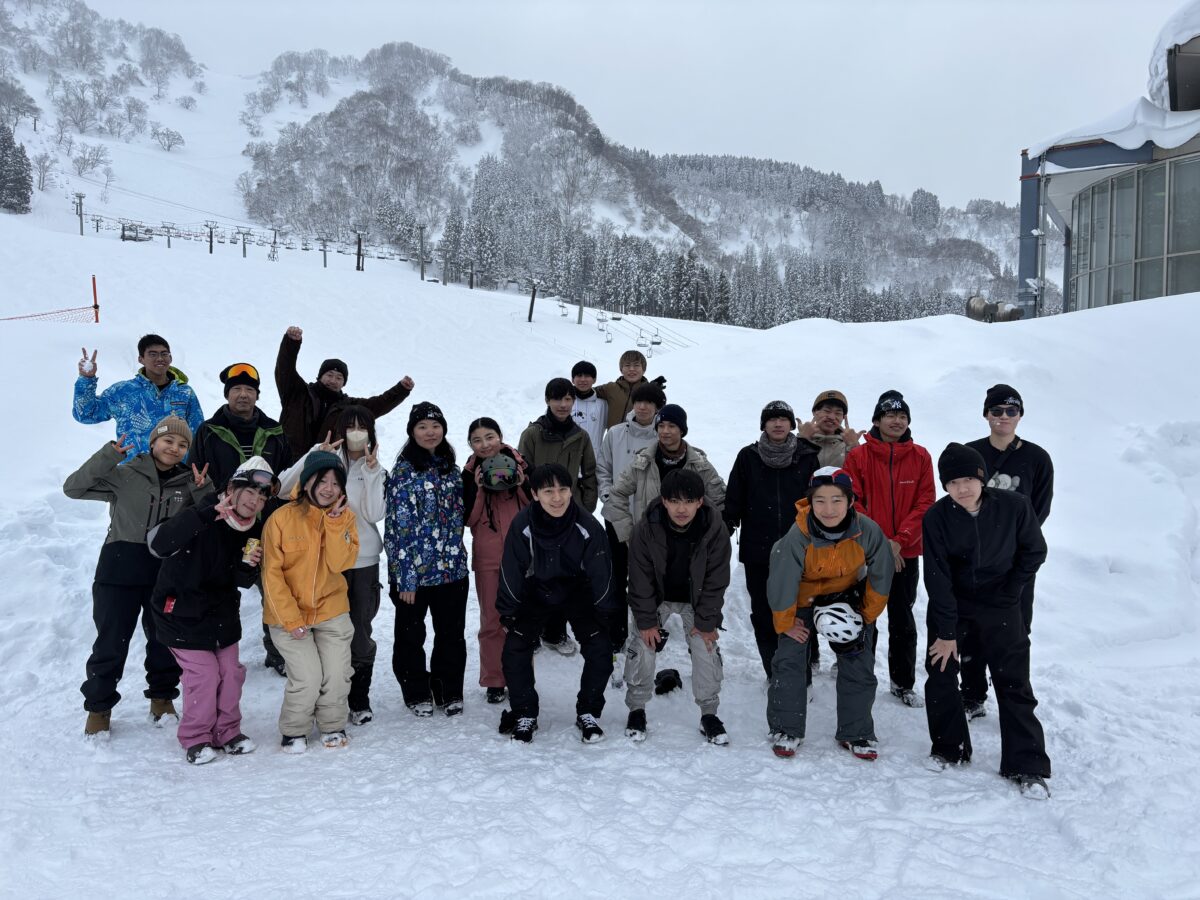

Hello, I am Shuntaro Tanaka, a 1st year student. I currently live in the dormitory at the Hakusanroku Campus. Since late January, it has been snowing heavily here, and everything outside is covered in white. The snow has piled up higher than my height, and it is so light that I was surprised when I saw it for the first time.
On Friday, February 7th, 2025, we went to Hakusan Ichirino Ski Resort, which is about 15 minutes away from the Hakusanroku Campus by bus. 1st and 2nd year students who wanted to join took part in this ski trip. In the morning, those who were new to skiing attended a ski lesson, while the others enjoyed skiing and snowboarding freely. The weather was clear in the morning, but around noon there was a brief snowstorm before it calmed down again, leaving behind soft powder snow.
I have been skiing since I was a child, so instead of taking the ski lesson, I went snowboarding for the third time. I was really impressed by how soft the powder snow was and how "it doesn’t even hurt when you fall."
After lunch, we met up with the students who had attended the ski lesson, and in the afternoon, everyone enjoyed skiing and snowboarding together. At first, those who took the ski lesson struggled, but three of them quickly got the hang of it and were able to ski smoothly. The other two had a harder time and fell many times, but with the support of the faculty, they kept trying. By the end, they had improved a lot and could ski with more confidence.
At that time, I could already snowboard, but my turns were a bit awkward, and I was struggling to control them. One of the faculty members, Omihito Matsushita sensei gave me some advice, which was helpful. Thanks to Matsushita sensei instructions, I was able to fix the movements I had been struggling with right away. However, the time passed so quickly that I still felt like I hadn’t snowboarded enough. I hope I get another chance to come back so that I can improve even more.


Shuntaro Tanaka
 Hello everyone, it's your friendly teacher Hayato Ogawa unrelated to the Japanese drama, Extremely Inappropriate! It’s been a gray and dark winter here in Hakusanroku campus but the light at the end of the school year is upon us and it’s filled with new adventures and goals for the next school year! My background is in electrical engineering with programming and telecommunications. I enjoy designing, creating, fixing and tinkering.
On Thursday, January 23rd, 2025, Tossa Mebusaya sensei and I held the final class in the Fundamentals of Business Management course. In the class students made their final business proposals. The proposals were a 3 to 5 minute pitch of an idea that would help develop a new awareness and help others have a better student life. The students have been working in teams from week 5 to bring awareness and resolve issues they have faced around and in school life.

The first group wanted to revise the process for requesting, acquiring and using the student discount for Japan Rail (JR) ticketing system. The target would help JR, students and the academic office staff who prepare the paperwork for this process. The current process is to acquire a student travel discount which is time consuming and frustrating. The students proposed a more direct and app-based solution and check system, all maintained in the JR ticket system. The app and check system has good security and user id confirmation checks to assure correct use by both student user and JR. This solution adds a new feature to the existing ticketing system and gates at JR by updating the check in check out system and creating a web application in conjunction with schools for ID checks and clearance for discount acquisitions. The students also proposed a strong revenue model and sustainable life cycle for the solution.

The second group brought awareness to the large amount of stink bugs in the area and on campus. This group’s proposed solution was a small robot that would incinerate the specific bug identified as a stink bug with a laser light source. With an interesting payment method where every time a stink bug is removed the user must pay per bug. With this revenue model it allows the homeowner or users to rent the robot from the company to in order to maintain a peaceful and stink free living space without the worry of stink bugs.

The third group wanted to have more interaction with the cafeteria staff and the food preparation and consumption process. This group wanted to use the Gordon Ramsay tv show called Kitchen Nightmares show concept and have a culinary coach to come in to shake up the school menu. The students wanted to see how they could be involved in communicating interest, curiosity and familiar tastes to cafeteria staff and share ideas through food. What kind of new creations would be made. The students offered a workshop like experience to update and collaborate with the current kitchen staff of different offerings and themes. The revenue model is a onetime fee dependent on catering size of the school/company facility and cafeteria.

The fourth group wanted to tackle the issue of noise in the living areas or dormitories to alert and give friendly reminders to other tenants, of loud behavior or disruptive noises being generated accidentally. They came up with a small device to keep track of peak noise levels in individual rooms and let a central system know of issues and patterns while alerting the noise maker. The system and dataset are sold to the facility management company as a subscription service and as a rental for the sensor and monitoring system.

The fifth group wanted to resolve the issues on difficulty of reading blackboard notes, how to digitize them and, with the help of AI, decipher hard to read handwritten notes. Target users were the students and people who may have a disadvantage of seeing the blackboard due to seat position or eye condition. This business would sell a subscription to the academic facility and would be included in the digital media cost to students to aid everyone and have ease of access to tools to help with studying.
This type of business proposal is similar to the American tv show Shark Tank where contestants have a very limited time to concisely hit attractive and informative points to stakeholders and investors so they gain interest and confidence in investing in a product or service. It is important to hit key points and have an open area for investors to come back to schedule another meeting to discuss more details.
Hayato Ogawa
Hello, this is Michihiro Hayashi, and I am in charge of the Engineering Design I course. Throughout the year, 1st year students have been working in this course with the goal of creating useful products for people. On Friday, January 24th, 2025, the students made their final project presentation. Each team conducted interviews with their target users to identify underlying issues and needs. Based on their findings, they developed devices to address these problems and presented their solutions.
I would like to introduce each team’s projects.
【Hot Spring (Onsen) Facility Hime no Yu Team A: Ocket】
Ryotetsu Sano, Madoka Nakazawa, Kotori Mae and Pantawat Lapananrat
The first team presented the Hot Spring Facility English Guide System.
On Hakusanroku campus, there is an onsen facility called "Hime no Yu," which is used by students, local residents and tourists. Through interviews with the onsen staff, students discovered that many foreign visitors who come to Hime no Yu for the first time struggle to understand the admission fees, ticket purchasing process, and onsen etiquette. They also found that it was challenging for the onsen staff to explain these details in English.
To address this issue, the students developed a system called “Ocket” that provides video explanations with English audio and subtitles on how to pay for admission and use the onsen properly. The tablet running the application is decorated in an inviting manner and includes a motion sensor that detects people approaching, triggering the guidance.
Additionally, the video features Mr. Pantawat Lapananrat, an international student from Thailand, making this project truly global.
-

Identifying problems with Hime no Yu「比咩の湯」の問題点を抽出
-

Introducing ideas from sketches to onsen staff温泉スタッフへスケッチによるアイデアを紹介
-

Introducing ideas from sketches to onsen staff温泉スタッフへスケッチによるアイデアを紹介
-

3D modeling in progress3Dモデリングを制作
-

Prototype in progressプロトタイプを制作
-

Prototype production with the laser cutterレーザーカッターでプロトタイプを製作
-

Creating a video動画を制作
-

Final presentation最終発表
-

Students created an English/Japanese application for Hime no Yu温泉施設英語案内
-

Introducing an application to teacherアプリを紹介


【Hot Spring (Onsen) Facility Hime no Yu Team B: Okojo L’Arc】
Shuntaro Tanaka and Chihiro Fukumoto
The next team presented the "Onsen Information Guide Mascot." Similar to the Onsen Team A, this group also developed a product to assist onsen staff. The Hime no Yu onsen staff frequently explain the facility’s features to customers. Through interviews, students discovered that onsen staff often struggle to communicate with foreign visitors and effectively convey the charm and appeal of the onsen.
The “Onsen Information Guide Mascot” is modeled after the Stoat (okojo), a native of Hakusan, and holds pamphlets and other goods in a tub in Stoat’s hand. The mascot also has a built-in speaker and can play messages recorded in English and Japanese by students to introduce the onsen. The original goal was to create a robot that could move around the onsen facility, but due to the number of students in the team, the plan was changed to stationary robot. Maybe they can try building a robot when they become upperclassmen.
-

Identifying problems with Hime no Yu「比咩の湯」の問題点を抽出
-

Presentation of ideas through sketches to teachersスケッチによるアイデアのプレゼンテーション
-

Receiving feedback from teachers教員たちからフィードバックをもらいます
-

3D modeling3Dモデリングを制作
-

Prototype production with the laser cutterレーザーカッターを使ってプロトタイプを製作
-

Making the prototypeプロトタイプを制作
-

Stoat (Okojo) has taken shape!オコジョが形になってきました!
-

Test board for electronic equipment that plays the guidance voice案内音声を再生する電子機器のテスト基板
-

Final presentation最終発表
-

Stoat (Okojo), holding a onsen tub, talks about Hime no Yu桶を持っておるオコジョが温泉についてお話します。


【Gym Team: Shuttlecock Collector】
Soma Ioroi, Hajime Tani and Seiya Fujiwara

Badminton Club Practice
The next team introduced the "Badminton Shuttlecock Collection Robot" to assist with gym cleanup. Through interviews with teachers who frequently use the gym, the team found that maintaining cleanliness was a common concern. At the Hakusanroku campus, the badminton club practices in the gym after school. After practice, collecting scattered shuttlecocks and placing them back into their cases is a tedious task. To address this, the Gym Team attempted to build a robot that would automatically place shuttlecocks into their tubes when thrown in the robot. Although they were unable to achieve full automation, they gained valuable insights into the challenges of transporting objects automatically. In particular, they realized that the feather of a shuttlecock makes it difficult to handle with an automated system. Reviewing and analyzing what didn’t work is just as important as achieving success—it will certainly be useful for their future projects.
-

Identifying problems with Gym体育館の問題点を抽出
-

3D modeling in progress3Dモデリングを制作
-

Prototype production with the laser cutterレーザーカッターでプロトタイプを製作
-

Making the prototypeプロトタイプを製作
-

Using the 3D printer3Dプリンタを操作
-

Making the prototypeプロトタイプを製作
-

Making the prototypeプロトタイプを製作
-

Final presentation最終発表
-

Final presentation 最終発表
-

Rotating conveyor belt which automatically collects shuttlecocks最終発表


【Maker Studio Team: Black Dame Dame】
Kaisyu Ishiharada, Ayane Ito and Ikki Hashimoto
The last team is the “Cleanup Time Notification Robot”. ICT has a mini factory called Maker Studio as a facility for making things. After school, it is always bustling with students who love to making things such as robots. However, when students are deeply focused on their work, they often do not start cleaning up even when the faculty managing the Maker Studio reminds them to do so. Additionally, they sometimes become so absorbed in their work that they forget about dinner and miss their meals. To address this, Marker Studio Team built a robot that moves around the Maker Studio when clean-up time approaches, displaying the current time and letting students know it’s time to clean up. The robot had large time display and a speaker to broadcast messages. Since several students on this team had participated in the NHK ROBOCON College of Technology contest , they were able to build a robot that was able to perform multiple functions such as moving by tires and displaying the time. I thought it was good that they were able to make use of what they had learned in their daily activities.
-

Interview with Daiki Wakamatsu sensei, the engineer who manages the Maker Studioメーカースタジオを管理している若松 大暉技師にインタビュー
-

3D modeling in progress3Dモデリングを制作
-

Making the prototypeプロトタイプを製作
-

Making the prototypeプロトタイプを製作
-

Carefully wiring the robot配線にこだわったそうです!
-

Making the prototypeプロトタイプを制作
-

Creating a video動画を制作
-

Final Presentation最終発表
-

Operating a robot最終発表
-

2nd year students tried to operate the robotロボットを動かす様子


All teams delivered their presentations in English, and naturally, the Q&A sessions with foreign faculty members are also conducted in English. Students who had attended Japanese middle schools sometimes struggled to find the right English words, but they confidently presented their self-made products using the English skills they had developed over their first year of study.
I look forward to seeing what new ideas students will come up with in future Engineering Design courses.
Michihiro Hayashi