






Hello everyone! This is Sade Moore, a Learning Mentor at the ICT Hakusanroku Campus! I have lived in Japan now for 6 years. For the first five years, I lived in Tsubata Town in Ishikawa before moving to the Hakusanroku Campus last year when I began working at ICT. Every year since I moved to Japan, I have taken part in an activity that has become close to my heart. Since the Spring of 2018, I have volunteered and helped the Kahoku Lagoon Lake Research Institute NPO (NPO法人 河北潟湖沼研究所) plant and harvest rice in their rice paddies on the edge of Tsubata Town and Kanazawa City.
From creating and laying down the nursery for the, what I have come to lovingly call my “rice babies”, in the early Spring, to weeding in the Summer, to finally cutting the rice stalks down by hand with a kama (鎌), I always have enjoyed taking care of my “rice babies” every year.

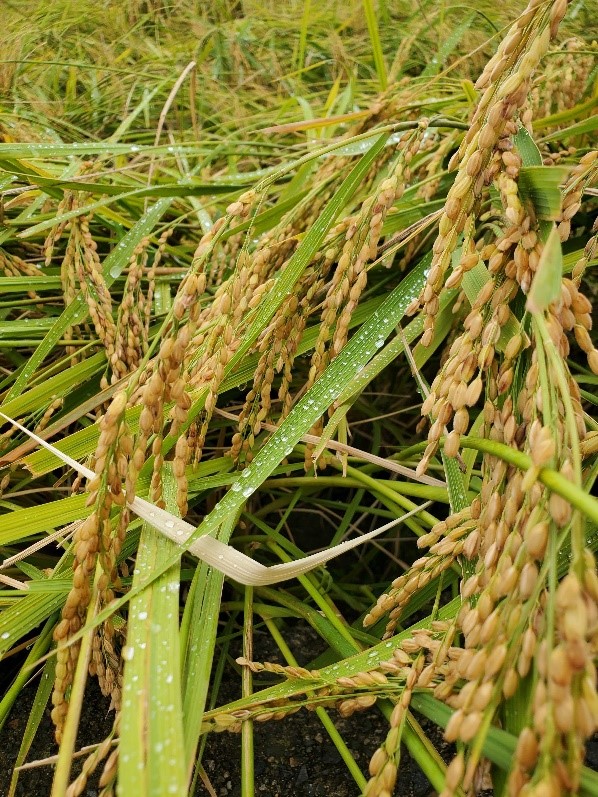


The overall process of the cultivation of the rice sounds quite simple, even if the actually labor can be a bit intensive. The left over rice that was not sold from the previous year’s harvest are used as seeds in early spring to create a nursery in the paddies and is planted inside the nursery plot and then covered with vinyl to create the optimal growing environment for the seeds to take root.


Once the sprouts have grown enough in the nursery plot, around late May we will then transplant the baby sprouts by hand into the 3 rice paddies. There is a small, medium, and large size rice paddy. In order to make sure that each of the sprouts are planted in the correct area, a traditional wooden takorogashi (田転がし) is used to create the grid pattern in the mud.


After all the seedlings are planted in the paddies, hand weeding takes place several times during the summer. In late September, the rice is then cut, bound, and hung on racks to dry in the sun for several weeks.


One of the important aspects about the rice for this organization is that the rice grown in these paddies are environmentally friendly. They do not use pesticides nor antibiotics to help grow the rice and I think it makes it even more healthy for people to eat. The Institute is also dedicated to community outreach and holds several events through out the year, both at the rice paddies, and around the Kahoku Lagoon. Specifically, during the events at the rice paddies, the ecology and environment of the rice paddies is discussed with elementary children and they search for many different animals, insects, and organisms that live and thrive in the paddy environment. The goal is to educate others about the ecosystems and fauna that are in and surround the Kahoku Lagoon and to preserve it with conservation outreach. There are also many different kinds of research projects taking place not only in the rice paddies but also around the Kahoku Lagoon that deal with conservation, ecology, agriculture, environmental protection, and preservation.


I also have learned a great deal about paddy ecology from these events and find myself comfortable as I did research when I was in university surround the ecology of animals living in small ponds and waterways in my home state of Virginia. Actually, because of this volunteering I have met and become acquainted to many professors and teachers at local universities such as Kanazawa University and Seiryo University and their students because they also come and volunteer for the rice paddies and we have had wonderful cross-institution interactions between each other. Now that I work here, I hope that I can represent ICT well in these conversations, and I also wish that our students could take part in such dialogues as well.
The planting, growth, and harvesting of the The Kahoku Lagoon Lake Research Institute NPO’s rice paddies is truly a community endeavor and it is one of the most enjoyable experiences that I have had since coming to Japan. I wish that I could also take our students to help with the rice paddies and learn about the ecology of them that I have come to cherish so much. Either way, the rice grown in these paddies is some of the most delicious rice I’ve ever tasted! Also, I think, it is one of the few places in Ishikawa that sells brown rice, which seems very difficult to find in Japan! I hope that everyone will be able to taste the love that we put into growing our “rice babies” when they eat it. It has been a wonderful experience and I look forward to continuing learning more about cultivating rice and the ecosystems that thrive within the rice paddies for many more years to come. I have also gained a wonderful “rice baby family” with the Kahoku Lake Institute and the participants, professors, students, and community members who join in helping at the rice paddies over the years. The connections and network that I have been able to create with this one opportunity is vast and I am thankful for all the time spent working in these fields. It truly has become one of my greatest “happy places” and a place that I feel at home and at ease at.


Sade Moore
 Hello, I am Haruki Ohta, a 3rd year student of ICT. I am currently studying abroad in New Zealand and enjoying the most wonderful life. Eight months have passed since April, and it is already December. Time really flies. I am so grateful to my parents for allowing me to enter ICT and study abroad in New Zealand. Thank you.
By the way, I ride a road bike in New Zealand. I didn't bring the bike from Japan, but bought a used bike in New Zealand for about 60,000 yen. It is for commuting and training. However, I had a certain assumption. "Dunedin is a city, so there are fewer mountains than Japan, it is flat, and a road bike is good." This was a big mistake. After buying a road bike, I was excited to explore the area around the school, but there were only steep slopes. My homestay is in an area with a series of steep slopes to the school, and there are many steep slopes with an average gradient of 14%, which is even difficult to walk on. You may be able to climb the slopes if you go on a mountain bike or electric bicycle, but road bikes require power because the gear ratio is small. Local people even push their bikes. In other words, it's "tough (I can't climb)". I completely regret it. When I commute, I ride while carrying a bag with my laptop and other items, which adds extra weight on top of the steep hills. To be honest, it's hell. But it is good for me and I think it is necessary to get stronger in competitions, so I haven't given up and ride almost every day without getting off my bike. After 8 months, I am now able to easily climb steep slopes (I think). I am happy that I have gotten a little stronger, but another problem has occurred. My thighs got too big and I can’t wear 90% of the pants I brought from Japan.
-

Lots of steep hills!激坂がたくさん!
-

Night practice夜練
-

The scene of riding my bike乗っている様子


I've been riding road bikes in New Zealand since April, and there have been many good and difficult things. What I learned here is "There is no limit! Break through with determination!" I've always had a strong spirit of challenge and have done many things, and of course I did stupid and dangerous things. But until now, I was just challenging myself, or I would give up if I thought it was even a little difficult. Through my road bike experience, I have been able to push myself and go beyond my limits. I think this is something that is common everywhere. At first, I thought I was bad at data analysis and programming for AI research, which I have never done before, but I persevered and am now gradually becoming good at it.
At first glance, road bikes may seem like just expensive bikes, but I think there is a lot to be gained from riding a road bike. It may be better to try something and put in a little effort. This is not just about road bikes, but rather it is about not being interested in anything or not trying anything because of prejudice.
I have been able to have a variety of experiences through this study abroad. It is rare to study abroad for a long period of time, such as a year, rather than a short period of time, and not everyone can experience it. I am truly grateful to my parents for allowing me to enter ICT and for giving me this valuable opportunity. I would like to live my life in New Zealand from now on, realizing that this is not something to be taken for granted and feeling grateful.
Haruki Ohta
-

Cycling wears which I received during practice with the national teamナショナルチームとの練習でもらったもの
-

-

My road bike僕のロードバイク


 Hello everyone. My name is Shogo Izumiya, and I am the chairperson of this year's ICT School Festival Executive Committee. I am very relieved, and at the same time sincerely happy that we were able to successfully hold the ICT School Festival on Saturday, October 19, 2024. Above all, I am very grateful to all the students and faculty members. It was the students' imagination and execution, as well as the help of the faculty and staff, that made this festival possible. I want to take this opportunity to express my gratitude once again.
Now, I would like to introduce, through this journal, what kind of events were carried out this year. Please take a moment to see the students' efforts and the lively environment they've cultivated.
During the day, exhibitions such as academic displays, ikebana exhibitions, and 1st year students’ art exhibitions were held at Maker Studio IV. Every year, 2nd year students take part in a practical course that covers the production-to-sale process of sweet potatoes. To check the progress, I visited the section where the results were exhibited. Another highlight was the 1st year students’ art exhibition, which featured numerous stunning works that showcased their enthusiasm and dedication. It was very touching to observe the activities and efforts of our junior students, something I don't usually get to see at Kanazawa campus.
-

ikebana exhibitions生け花展覧会
-

ikebana exhibitions生け花展覧会
-

ikebana exhibitions生け花展覧会
-

ikebana exhibitions生け花展覧会
-

student exhibitions成果物展示
-

student exhibitions成果物展示
-

Principal Shikada tries out Sphero at the exhibition booth展示ブースにてSpheroを体験する鹿田校長先生
-

Parents viewing Robocon robotロボットを見学する父兄の方々
In a place called the Learning Commons, two competitions were held in the morning and one in the afternoon. The first one was a card game tournament. The junior students of Hakusanroku Campus organized the event and brought the card games they usually enjoy to the desks in the Learning Commons for everyone to enjoy. The number and variety of cards they had were so large that we felt their enthusiasm was tremendous.
Next up was "Defeat Anish Kirpalani in a fighting game." You might be surprised by the name, but there's a 5th year student, Anish-senpai, who is a master of fighting games. This event was about defeating him in a particular game and winning a prize! These types of games can only be enjoyed on desktop computers or console gaming systems, so the preparation was a bit challenging. Although it was a game I wasn’t very familiar with, it turned out to be a wonderful event where we could interact with the senior students and have fun. Actually, my father, who came to watch, also tried it and managed to win with some handicaps.
In the afternoon, we had the "Big Fighting Game Tournament." Although we can't disclose the title of the game, we’ll leave it to your imagination. This event was held in a tournament format with a total of 18 players battling fiercely for prizes. The junior students were incredibly skilled, and I unfortunately lost in the quarter-finals. Each match was thrilling and kept us on the edge of our seats, making the experience immensely enjoyable.
-

Students facilitating a game tournamentゲーム大会を進行する学生たち
-

Photos of the game tournamentゲーム大会の様子
-

Enjoying a card game tournamentカードゲーム大会を楽しむ様子
-

Photos of the game tournamentゲーム大会の様子
-

My father trying the game for the first timeアニッシュ先輩に挑戦する父
-

Anish senpai and my fatherアニッシュ先輩と父
After these events, the highlight of the day was the Bingo game. It was incredibly fun and lively, with the excitement of getting close to a Bingo but not quite hitting it, adding to the atmosphere. This annual event features gorgeous prizes that were competed for in the order of the earliest bingo winners. As more and more people got closer to bingo, I was enjoyed how everyone started fidgeting every time I brought out the bingo ball.
After the Bingo game, the final event was a debriefing session for the Kosen ROBOCON 2024 held in early October. With this, this year's ICT School Festival came to an end. Lately, ICT has begun actively participating in the Kosen ROBOCON, and their hard work and creativity, along with their perseverance in repeatedly testing and improving their ideas, make me proud as ICT student. Best of luck for next year as well!
-

Me running the Bingo gameビンゴ大会での私
-

Photos of the bingo gameビンゴ大会の様子
-

Robocon A Team高専ロボコンAチーム
-

Robocon B Team高専ロボコンBチーム
-

My closing speech at the end of the ICT festival 高専祭閉会の挨拶をする私


Well, here is a summary of this year's ICT School Festival along with my impressions. How was it? ICT has just begun. Many students are now enrolling in our school, and the number of attractive junior students is increasing rapidly. We will continue to create better events in the future, and we look forward to seeing you again at next year's ICT School Festival.
Shogo Izumiya

 Hello, I’m Taichi Eguchi, a 2nd year student.
On Saturday, October 19th and Sunday, October 20th, 2024, the 35th National College of Technology Programming Contest (Kosen ProCon) was held in Nara Prefecture. A five-member 1st year and 2nd year student team competed in the Themed Section. For more information on the Kosen ProCon and the presentations by the ICT students’ team: Five Students Participated in the 35th National College of Technology Programming Contest
In the qualifying round, we had less than two months to come up with an idea from scratch with our team members. We worked out what kind of product we would make, had Meguru Ito sensei check our qualifying materials many times, made many revisions, and submitted our proposal well in advance of the deadline.
We received an A grade and passed the qualifying round. After this, the team members were assigned different roles to complete the product. I had the job of creating the mobile application. I had to use a JavaScript framework called React Native. It was the first time I used React Native and JavaScript, so first I had to research these programing languages so I could create the mobile application, step by step. It was a lot of fun to learn new things as I researched and implemented them one by one, and to see things that I envisioned coming to completion.
I was also the leader of the team. All the team members worked on their own jobs and consulted with me on matters they did not understand. I was able to trust them and concentrate on application development without having to spend much time managing the team. I have the impression that the project went smoothly. I felt a great sense of accomplishment when the application was completed.
Due to time constraints, we were not able to experiment with the finished product. However, we received many suggestions for improvement that we did not notice on our own or that would be problematic if we used the product.
At the end of the two days of the competition, we did not receive any special awards, but I thought it was a great experience for the team to think and work from zero to completion of the project. Also, we completed the project, which made me feel relieved. After having participated in the programming contests last year and this year, I decided that I wanted to do it again. When I become 4th year student, I want to use the feedback the team received at this year’s competition and win an award.


Taichi Eguchi

Have you ever heard of a "learning mentor"? Many people may not know a lot about this job and I want to share what my day is like.
My name is Apirak Sang-ngenchai, and I am a learning mentor. My work begins in the afternoon when I join the classes I am assigned to. I usually sit at the back of the classroom to listen to the lecture in order to understand the topics and context, which helps me better support the students later on. If students have questions, I provide explanations. Sometimes, I assist students who feel shy about speaking up in class.


The evening learning session runs from 7:30 p.m. to 9:30 p.m. This is the heart of my job. Students come to me for help with their studies during these two hours.
●Homework and Quizzes: During the evening session, many students bring their homework to ask for guidance. Some assignments are straightforward, like math problems or writing exercises, but others can be more complex, like science reports or project research.
●Projects and Activities: Not all students come for help with homework. Some need support for extracurricular activities or personal projects. For students interested in robotics, I help them design, build, and program robots for competitions like Robocon. This includes brainstorming ideas, debugging code, and testing the robot’s performance. Some students have their own goals, like creating a small AI application or programming a game. I guide them by teaching coding techniques, suggesting tools, and troubleshooting their problems. It’s inspiring to see their creativity and determination.
●Life Issues: Some students just want to talk. They share their worries or ask for life advice. Some students need someone to talk to. They might feel stressed about exams, homesick, or unsure about their future plans. I listen without judgment and offer encouragement. Other students ask for advice on balancing school and personal life, building friendships, or setting goals. I try to give them practical tips and share my own experiences to help them feel more confident.


Learning mentors are like the students' older brother or sister. We play, study, and enjoy time together. It’s not just about schoolwork. It’s about building relationships. Students often feel more comfortable sharing their thoughts with me than with their teachers. For example, some students ask me for help with programming, especially for robots or AI. Then I guide them step by step through the process, and it makes me happy to see their progress.


Besides helping students with their studies, learning mentors organize events like Halloween parties, Christmas celebrations, or cultural festivals. These events help students feel more connected to each other and the school.


Being a learning mentor is busy, but it is also very rewarding. The best part of the job is watching students grow, solve problems, and become more confident. We are not just helping them with school; we are helping them with life. Now if you meet a learning mentor, you know what we do!
Apirak Sang-ngenchai